
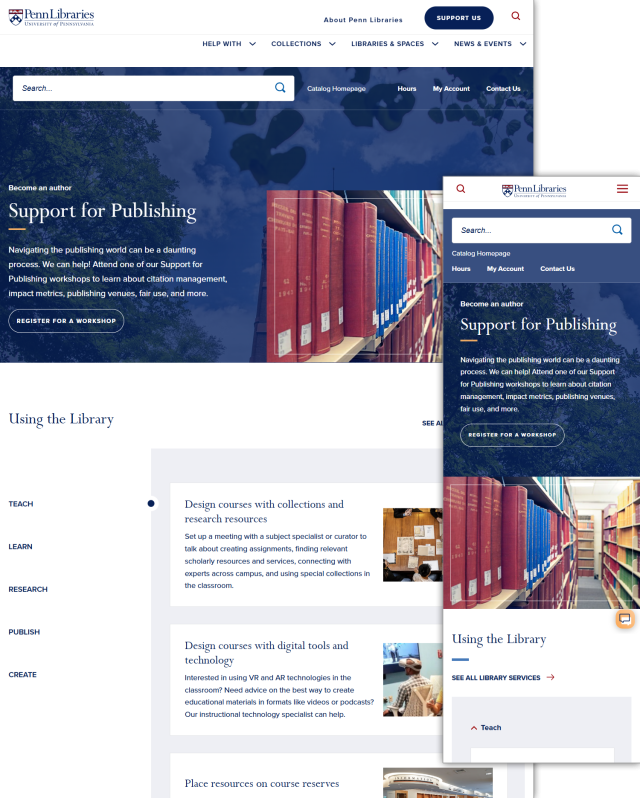

Penn Libraries
Penn Libraries, the library system of the University of Pennsylvania, supports 19 individual libraries, millions of volumes, and a broad suite of services spanning research support, digital resources, course reserves, special collections, and public access. I led the full Drupal build of their main public-facing site, architecting a platform built to handle deep content complexity, robust search/catalog links, and flexible editorial needs.
Component-Based, Flexible Content Architecture
Using the Paragraphs module, I built a modular content system that allows editors and librarians to assemble rich, varied pages — from service guides and publishing support pages to space-booking, resource catalogs, news & events, and more. This component-driven approach gives Penn Libraries the flexibility to evolve their content over time while maintaining design consistency and editorial control, a pattern widely recognized as best practice in Drupal site building.
Support for Diverse Services, Resources & Collections
The site architecture supports everything from descriptive guides of library services (study spaces, digital media labs, course reserves, interlibrary loan, etc.) to complex catalog search integrations, subscription resources, research-data guides, and special-collections access. Given the scope and scale of Penn’s holdings — spanning many libraries, formats, and user types — building a site that surfaces all this clearly and accessibly was a significant challenge; the build needed to balance ease of use for students and faculty with the metadata complexity behind the scenes.
Scalable, Maintainable, Editor-Friendly System
Because the library site needed to scale with growing collections and evolving services, the architecture emphasized maintainability, performance, and clarity. The use of structured components, clear content types, and consistent layout patterns means editors can add or update content without developer intervention. Given how frequently academic libraries evolve (new resources, services, guides, event postings, research support updates, etc.), having a flexible yet stable system was critical.
This project underscores my experience building large-scale, content-rich Drupal platforms — especially for academic or institutional clients — and delivering a maintainable, flexible, future-proof architecture that meets complex editorial and user needs.
